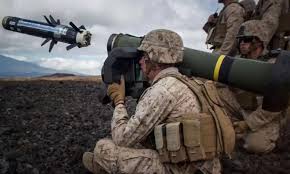
The FGM-148 Javelin Missile system, a man-portable anti-tank guided missile (ATGM), is set to boost India’s defense capabilities following a $93 million (approximately ₹825 crore) arms deal approved by the US. Developed by Raytheon and Lockheed Martin, the Javelin is a “fire-and-forget” missile highly regarded globally, especially after its effective use by Ukraine against Russian tanks. India’s acquisition includes one Javelin missile, 100 Excalibur guided artillery rounds, and 25 lightweight Command Launch Units (CLU).
A crucial feature of the Javelin is its unique launch mechanism, designed to prevent detection by the enemy. Unlike conventional anti-tank weapons that emit smoke and heat immediately upon firing, the Javelin uses a small motor to first eject the missile a short distance from the launch tube. Only then does the main missile motor ignite, propelling it toward the target. This delay, combined with its computer-guided precision, prevents the enemy from accurately identifying the launch position using heat sensors, allowing the operator to relocate quickly.
The Javelin offers two distinct operational modes for engaging targets. The first is the Top Attack Mode, where the missile ascends to an altitude of about 500 feet before diving down onto the tank’s top armor, which is typically its weakest point. The second is the Direct Attack Option, where the missile travels straight to hit the target, making it suitable for destroying fortified positions like bunkers, buildings, or lightly armored military vehicles. The missile itself is equipped with two explosive warheads, designed to penetrate reactive armor protection and destroy the tank.