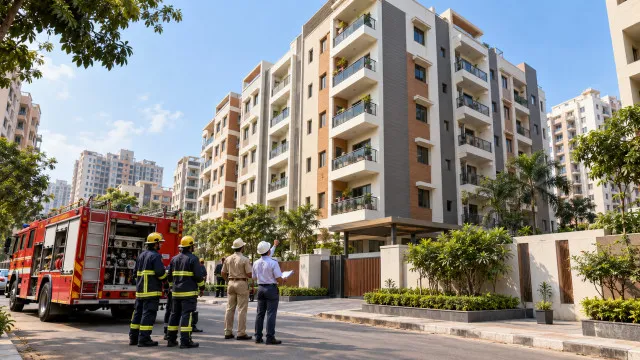
The Telangana Fire Services Department has raised the height threshold at which new residential apartment buildings require a provisional Fire No Objection Certificate (NOC), increasing it from 18 metres to 24 metres. The revised rule is expected to come into effect from October 7, according to Fire Department officials.
Under the existing system, residential apartment buildings measuring 18 metres or more in height were required to obtain a provisional Fire NOC before construction approval. The revised threshold means apartment buildings between 18 metres and 24 metres — broadly corresponding to buildings of around five to seven upper floors depending on design — will no longer require the provisional Fire NOC solely on the basis of height.
The relaxation applies specifically to residential apartment buildings. Schools, hospitals, hotels, hostels, industrial buildings, shopping malls, offices and other buildings intended for commercial or public use will continue to be governed by the applicable fire-safety requirements.
Officials said the revision followed consultations with builders’ associations and was aligned with the National Building Construction Standards (NBCS) 2026.
The Bureau of Indian Standards established NBCS 2026 on April 30, replacing the National Building Code of India 2016. The revised national standards use 24 metres as a significant threshold for fire and life-safety provisions relating to residential buildings.
Telangana Director General of Fire Services Vikram Singh Mann said the revised approach was intended to simplify the approval process and reduce the regulatory burden on lower and mid-rise residential buildings.
However, buildings falling below the revised Fire NOC threshold will not be exempt from basic fire-safety requirements. Fire officials are expected to carry out periodic inspections during construction to check provisions such as unobstructed exits, emergency lighting, fire extinguishers and electrical safety.
Fire-safety specialists have cautioned that building height alone does not determine fire risk. S.P. Anchuri, vice-president of the Council for Fire and Life Safety, said factors including occupant density, evacuation arrangements, smoke management, firefighting installations and access for fire tenders should also be taken into account.
He said residential buildings between 18 metres and 24 metres should maintain clear escape routes, protected staircases, emergency lighting and signage, proper smoke-management systems, safe electrical installations, fire-detection and alarm systems and adequate firefighting equipment.
Experts have also highlighted risks commonly found in apartment complexes, including blocked staircases, locked terraces, storage of materials in common areas, unauthorised electrical alterations and vehicles obstructing access for fire tenders.
They stressed that fire-safety compliance should continue after occupation, as maintenance failures or subsequent alterations can undermine safety measures incorporated during construction.