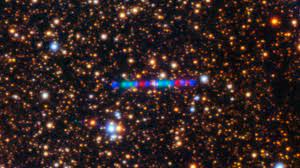
NASA has made a groundbreaking discovery by detecting the chemical “fingerprint” of water on the interstellar comet 3I/ATLAS, a rare visitor from beyond our Solar System. This first-of-its-kind finding on an interstellar comet has significant implications for planetary science and the search for life’s ingredients across the galaxy.
The Water Breakthrough and Unexpected Activity
Using NASA’s Neil Gehrels Swift Observatory, scientists detected a faint ultraviolet signal from hydroxyl (OH) gas, which is the direct byproduct of water molecules breaking apart under sunlight. This provided the first concrete chemical evidence of water activity on an interstellar comet. What is highly unusual is that 3I/ATLAS was losing water at a rate of roughly 40 kilograms per second (the output of a fire hose) despite being nearly three times farther from the Sun than Earth—a distance where water ice should not typically vaporize. Scientists theorize this unexpected activity is caused by the faint sunlight efficiently heating small, ice-coated dust grains that are being released from the comet’s nucleus.
Significance for Life and Planetary Formation
The discovery of water on 3I/ATLAS strongly suggests that the essential ingredients for life are not unique to our Solar System, hinting that life’s chemistry may be universal. This comet, estimated to be around seven billion years old, is a crucial messenger from another planetary system, offering a rare glimpse into the chemistry of distant worlds. By studying its composition, astronomers can directly compare it to comets formed in our Solar System and the previous, compositionally diverse interstellar objects, ‘Oumuamua (dry) and Borisov (carbon monoxide-rich). “Each interstellar comet we’ve observed has rewritten the rules,” said Prof. Dennis Bodewits, emphasizing that this is a time capsule revealing how ancient star systems evolve.
Would you be interested in learning about the other two previously discovered interstellar objects, ‘Oumuamua and Borisov, and how 3I/ATLAS compares to them?