Pakistan’s ranking as the worst affected country in the 2026 Global Terrorism Index, despite a global decline in terrorism, exposes its deep-rooted internal challenges. The data in the index underscores both the immediate impact of violence and the long-term repercussions of structural and strategic policy choices, a report has highlighted.
According to a report in Greek City Times, this represents a statistical reality positioning Pakistan at the centre of the global terrorism landscape, shaped by patterns that have evolved over the years and continue to influence its present.
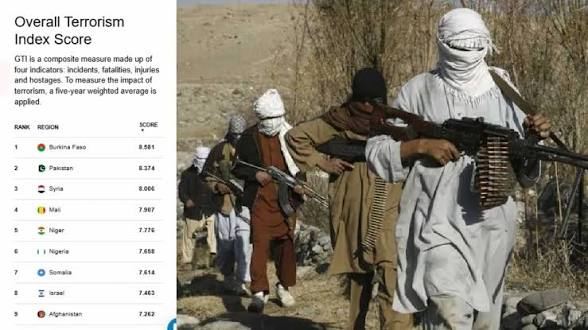
“In a year when much of the world recorded a decline in terrorism, Pakistan moved sharply in the opposite direction. The Global Terrorism Index 2026 presents a stark statistical portrait: Pakistan now ranks as the most terrorism-affected country in the world. The figures are not abstract,” the report detailed.
“In 2025 alone, the country recorded 1,139 deaths, 1,045 attacks, 1,595 injuries and 655 hostages. Its score of 8.574 places it above all other nations on the index, marking its deadliest year since 2013. This reversal stands out against a global backdrop of improvement,” it added.
The report noted that violence in Pakistan remains geographically concentrated, with the provinces of Khyber Pakhtunkhwa and Balochistan accounting for 74 per cent of all attacks and 67 per cent of total deaths in 2025.
These regions, it said, defined by persistent instability and limited state control, continue to serve as the epicentre of militant activity.
The analysis of the borderlands, the report said, attributes the pattern to decades of permissive conditions along the Afghanistan-Pakistan frontier.
The tribal belt in Pakistan, the report said, long partially governed, provided a safe haven for terror groups, including al-Qaeda, the Haqqani Network and, subsequently, domestic outfits.
“The continuity of ethnic and social networks across the Durand Line has further enabled cross-border movement, complicating enforcement and surveillance. These structural conditions, highlighted in the index, underscore a longstanding challenge: militant networks operating within environments where governance remains fragmented and contested,” it mentioned.
The report highlighted that the Global Terrorism Index projects Pakistan’s present situation as the cumulative impact of long-term structural and policy decisions.
The identified factors — ranging from permissive border regions to ideological networks and evolving militant ecosystems — reflect patterns that have evolved over decades.
Asserting that the findings are based on consistent trends rather than isolated incidents, the report said, “The rise in attacks, the concentration of violence in specific regions, and the prominence of particular groups all point to a system under sustained pressure. Pakistan’s position at the top of the index is not presented as an anomaly but as the result of an extended trajectory. The data suggests that the drivers of this trajectory remain active, continuing to shape the country’s security landscape.”