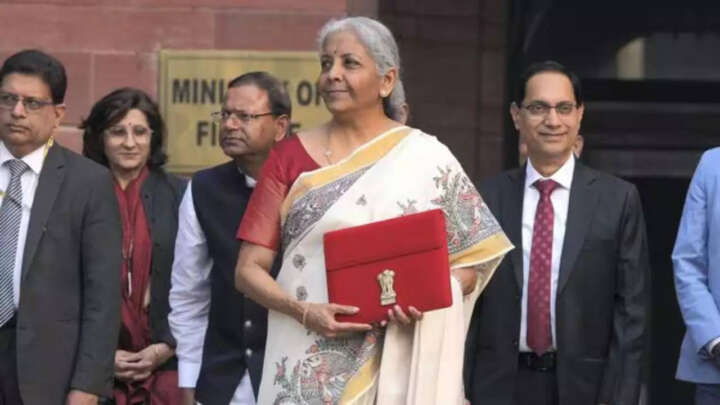
Finance Minister Nirmala Sitharaman is preparing to present her eighth consecutive Union Budget, a milestone that will surpass the record of former Prime Minister Morarji Desai. While her economic strategies often dominate discussions, there is another aspect of her budget presentations that consistently captures public attention—her choice of attire. Specifically, her selection of handwoven sarees, which carry deep cultural significance and a connection to India’s diverse regions, adding an extra layer of meaning to her economic statements.
Advertisement · Scroll to continue
Each year, as Sitharaman steps forward to announce the Union Budget, her saree becomes more than just a fashion statement. It symbolizes India’s rich handloom heritage, reflects regional pride, and often subtly hints at the sectors or states highlighted in the budget. Here’s a look at her saree choices over the years and what they have symbolized.
Union Budget 2025: Off-White Saree with Golden Border
In 2025, Sitharaman made an elegant statement with an off-white saree featuring a golden border and a beautiful Madhubani print. This choice continued her tradition of showcasing India’s handwoven textiles, celebrating their cultural richness and the stories they tell. The Madhubani print, originating from Bihar, is known for its intricate designs that often depict nature, mythological scenes, and daily life, further symbolizing India’s deep artistic heritage.
Union Budget 2024: Off-White Mangalagiri Saree
For the 2024 budget, Sitharaman chose an off-white Mangalagiri saree with a bright magenta border. Mangalagiri sarees, from the Guntur district in Andhra Pradesh, are known for their simplicity and elegance, with clean borders and a plain yet graceful design. This choice was particularly meaningful, as the budget included significant funding for Andhra Pradesh, such as investments in the Polavaram irrigation project aimed at benefiting the state’s agriculture sector.
Union Budget 2023: Red Silk with Temple Borders
In 2023, Sitharaman made a bold statement with a rich red silk saree featuring a black-and-gold temple border, a distinctive South Indian style. The temple border, adorned with symbols like chariots, peacocks, and lotuses, reflects tradition, strength, and stability. The red silk color also represented power and vitality, perfectly capturing Sitharaman’s confident presentation of India’s economic blueprint.
Union Budget 2022: Deep Brown Bomkai Saree from Odisha
For the 2022 Union Budget, Sitharaman wore a deep brown Bomkai saree from Odisha, with silver zari work and intricate border patterns. Bomkai sarees, hailing from the Ganjam district, are famous for their detailed designs inspired by nature and mythology. By wearing this saree, Sitharaman paid tribute to Odisha’s handloom legacy and highlighted the government’s commitment to preserving traditional crafts and supporting local artisans.
Union Budget 2021: Colorful Pochampally Ikat Saree from Telangana
Sitharaman chose a colorful Pochampally ikat saree from Telangana for the 2021 budget, with vibrant hues of red, off-white, and green. The ikat weaving technique, known for its vibrant patterns and intricate designs, represents growth and renewal. This choice mirrored the government’s ambitious economic recovery plans during the pandemic, symbolizing India’s hope for progress and resilience.
Union Budget 2020: Bright Yellow Silk Saree with Blue Border
In 2020, Sitharaman presented a bright yellow silk saree with a blue border, each color carrying significant meaning. Yellow symbolizes growth, hope, and new beginnings, while blue represents stability and peace. Her saree conveyed a message of hope and strength, particularly important as India faced the challenges posed by the COVID-19 pandemic. It reflected the government’s focus on recovery and long-term growth.
Union Budget 2019: A Memorable Start in Pink Mangalagiri Saree
For her first-ever Union Budget presentation in 2019, Sitharaman wore a bright pink Mangalagiri saree with a gold border. The color pink symbolized a fresh approach and new beginnings, while the gold border highlighted India’s rich textile history. She also made history by carrying the budget papers in a “bahi khata” (traditional ledger) rather than the colonial-style briefcase, merging India’s cultural heritage with modern economic policies.
Nirmala Sitharaman’s Sarees While Presenting Union Budget: A Reflection of India’s Unity and Vision
Nirmala Sitharaman’s saree choices are far more than just a fashion statement; they are a powerful symbol of India’s diversity, heritage, and ambition. Each saree she wears highlights regional handloom traditions while subtly reflecting the government’s policy priorities. Whether celebrating Odisha’s Bomkai designs or symbolizing growth with Pochampally Ikat, her sarees are a tribute to India’s craftsmanship and its deep cultural roots.
By choosing sarees woven by local artisans, Sitharaman champions sustainability, cultural preservation, and national pride. Each saree tells a story—whether it’s of India’s past, its cultural diversity, or its hopes for the future.
As the Union Budget 2025 approaches, people are eager to see which handwoven saree she will choose next. In a world dominated by fast fashion and global trends, Sitharaman’s saree choices serve as a reminder that true elegance lies in staying connected to one’s roots, celebrating the beauty of diversity, and making choices that reflect meaningful values.