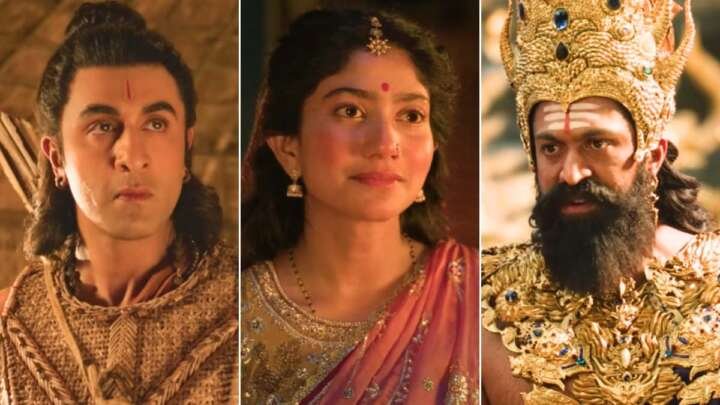
The ancient epic Ramayana has been adapted for the big screen several times. With every new version, filmmakers have used advanced technology to present the story in a fresh and visually appealing way. This time, Ranbir Kapoor, Sai Pallavi and Yash play the lead roles in the big-budget film directed by Nitesh Tiwari. Released in theatres today, let’s see how far Ramayana Part-1 succeeds in impressing the audience.
Story
The battle between the Devas and Asuras has been continuing since ancient times, with the Devas repeatedly gaining the upper hand. Ravana’s mother, Kaikasi, is unhappy with this situation and encourages her son to gain the power needed to defeat the Devas. Through severe penance, Ravana pleases Lord Brahma and receives several boons. He defeats Kubera, takes control of his kingdom and leads a happy life with Mandodari.
Meanwhile, King Dasharatha rules Ayodhya. His three wives give birth to four sons — Rama, Lakshmana, Bharata and Shatrughna. Rama accompanies Sage Vishwamitra and kills the demons Subahu and Tataka. He later marries King Janaka’s daughter, Sita, through a swayamvara.
After Rama returns to Ayodhya, Dasharatha begins preparations for his coronation. However, due to the boons he had previously promised Kaikeyi, Dasharatha is forced to send Rama into exile.
During their stay in Panchavati, Lakshmana builds a small forest dwelling for Rama and Sita. One day, Surpanakha arrives and develops feelings for Rama. Lakshmana cuts off her nose and sends her away. Humiliated and heartbroken, Surpanakha approaches her family and demands revenge.
What do her Asura brothers do in response? What consequences follow this incident? The rest of the story deals with these developments.
Analysis
The story of the Ramayana is already familiar to most audiences. However, every new adaptation creates curiosity about how the epic has been presented, how the actors have performed and how effectively the filmmaker has brought the story to life on screen.
Coming relatively soon after Adipurush, this big-budget adaptation naturally generated greater interest. Since Adipurush faced considerable criticism, audiences were particularly curious to see how this version would turn out.
The narrative follows the familiar events in a straightforward order. On one side, Ravana increases his powers through penance. On the other, Rama becomes skilled in using various weapons. The story then moves through Vishwamitra’s yajna, Sita’s swayamvara, Rama’s exile, Surpanakha’s humiliation, Ravana’s abduction of Sita and Rama and Lakshmana setting out to find her.
The film moves quickly between Ravana’s attacks on the Devas and Rama’s journey of defeating the Asuras. The action sequences, supported by impressive graphics, are visually engaging. The events unfolding in Lanka and Ayodhya also keep the audience entertained.
One interesting aspect is that the story begins with Ravana’s mother, Kaikasi, played by Shobana, and includes action sequences involving her character. Most earlier Ramayana adaptations did not give much importance to Kaikasi. Highlighting her role here feels refreshing.
Similarly, Surpanakha’s husband, Vidyutjihva, is a character who has rarely received much attention in previous adaptations. The way the film indirectly connects his character to Sita’s abduction is an interesting addition.
However, a couple of sequences feel unusual. In one scene, Sita runs alongside Rama and Lakshmana while an Asura army chases them. While Rama and Lakshmana run to gain time to use their weapons, Sita running along with them feels somewhat awkward.
Likewise, showing Sita wielding a sword and participating in battles is difficult to accept within the familiar portrayal of the character. The use of rhinoceroses and lions as mounts also appears to be part of the filmmakers’ attempt to introduce something new.
The visual presentation of Lanka, Ayodhya and Mithila is among the film’s biggest strengths. The cities have been recreated on a grand scale. The design of the royal palaces, costumes, chariots, weapons, ornaments and Pushpaka Vimana is impressive.
Several sequences stand out, particularly Ravana arriving in the Pushpaka Vimana to abduct Sita, Jatayu attempting to stop him on his return journey, and Rama creating a whirlwind to control the Asuras. These moments are major visual highlights of the film.
Performances and Technical Aspects
Lord Rama is traditionally described as Neelamegha Shyama, referring to his dark, cloud-like complexion. Earlier films often portrayed him with a blue complexion. In contrast, this film presents Rama with a natural skin tone, which comes as a surprise.
The tilak designs used on the foreheads of both male and female characters also do not appear to have received enough attention.
When Ranbir Kapoor first appears as Rama and Sai Pallavi enters as Sita, they do not immediately seem convincing in their respective roles. However, as the film progresses, the audience gradually gets used to their appearances.
The film also fails to establish Vibhishana’s character effectively. Kajal, who plays Mandodari, is not given enough scope to make an impact.
Another disappointment is that the first part ends before Hanuman’s entry. More importantly, the absence of emotionally touching and memorable songs leaves a noticeable gap in the film.
On the technical front, Pankaj Kumar’s cinematography, A. R. Rahman’s background score and Huzefa Lokhandwala’s editing make strong efforts to elevate the film. The impressive visuals, action sequences and large-scale production design add considerable value to the viewing experience.
Final Verdict
Ramayana Part-1 follows the familiar storytelling style of earlier films based on the Ramayana, without making major changes to the central narrative. While certain character portrayals, creative choices and the lack of memorable songs are disappointing, the film makes up for some of these shortcomings with its spectacular visuals and impressive action sequences.
Overall, Ramayana Part-1 is a visually impressive retelling of the epic that offers a grand cinematic experience, even though its emotional impact remains limited.