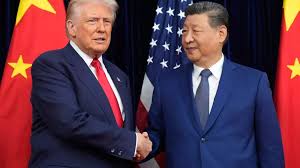
Ahead of President Donald Trump’s first visit to China since beginning his second term, Beijing has sent a pointed message to Washington by drawing “four red lines” that must not be crossed. As Trump prepares for high-level talks with Xi Jinping, the Chinese Embassy in the U.S. took to social media to reiterate that there will be no compromise on four specific core areas: Taiwan, Democracy and Human Rights, China’s Political System, and Development Rights. This move signals a rigid stance from Beijing, emphasizing that mutual respect and non-interference are the only paths to a stable bilateral relationship.
The issue of Taiwan remains the most sensitive “red line.” China continues to view Taiwan as its own territory and has expressed strong opposition to U.S. arms sales to the island. Ahead of the summit, Zhang Han, spokesperson for the Taiwan Affairs Office, urged the U.S. to honor its previous commitments, asserting that Taiwan is an internal matter. Furthermore, Beijing has warned Washington not to use “democracy and human rights” as a pretext to interfere in China’s domestic affairs or to challenge the socialist system led by the Communist Party of China.
Beyond these political boundaries, the visit comes amidst a backdrop of intense economic and technological competition. China has demanded that the U.S. cease efforts to block its economic and technological growth, framing development as an inherent right. The discussions between Trump and Xi are expected to cover a wide range of volatile topics, including China’s control over rare earth mineral exports, dominance in Artificial Intelligence (AI), and Beijing’s continued defiance of U.S. sanctions on Iranian crude oil. How Trump navigates these “red lines” will likely define the trajectory of U.S.-China relations for years to come.